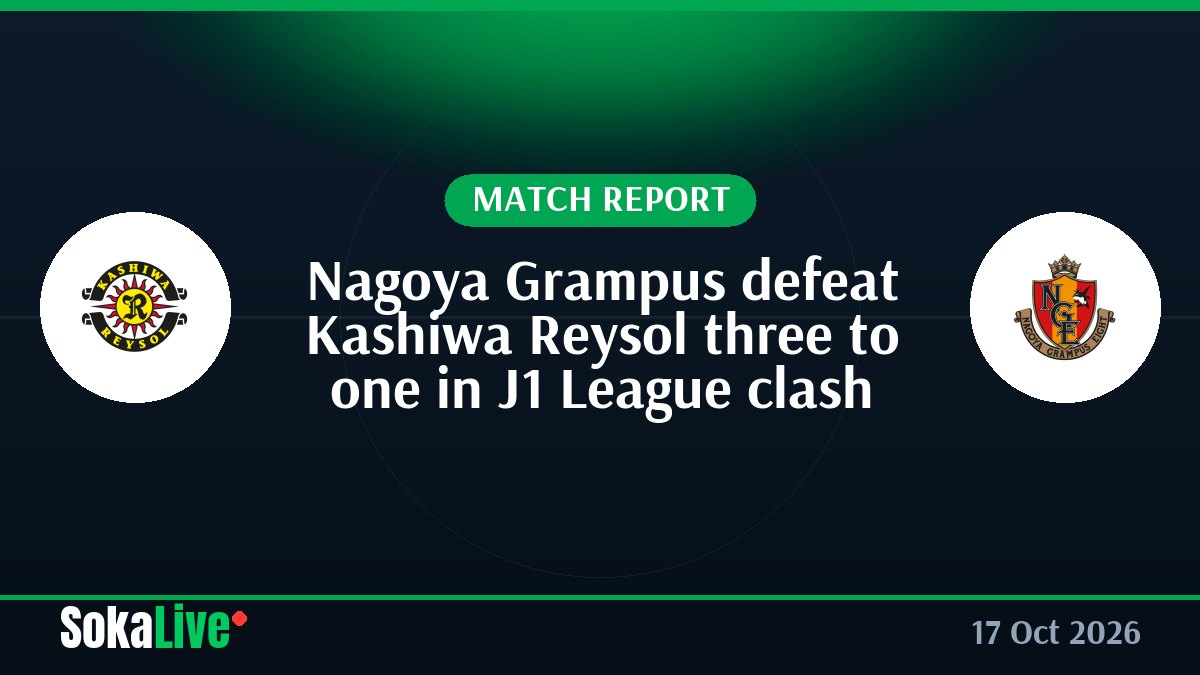
Nagoya Grampus secured a notable victory on Saturday, defeating Kashiwa Reysol one to three in their J1 League encounter. The match provided plenty of talking points across the ninety minutes of competitive action. Both teams entered the fixture with contrasting league positions and recent form trajectories. The visitors ultimately made their chances count to claim the three points on offer.
Going into this match, Kashiwa Reysol were sitting comfortably in third position in the J1 League table. They had played ten matches, winning seven and losing three, accumulating twenty-one points with twenty-two goals scored and seventeen conceded. Their recent form had been generally strong, featuring victories over Port FC by five goals to one, Vissel Kobe by four goals to two, Machida Zelvia by four goals to two, and Kyoto Sanga by three goals to two, alongside a single defeat by one goal to two against Jeonbuk Motors.
Conversely, Nagoya Grampus arrived at the fixture occupying twelfth place in the standings after ten matches played. They had recorded four wins and six losses, yielding twelve points, having found the net twelve times while conceding sixteen goals. Their preceding matches showed a difficult run of results, including a two to one win over Kawasaki Frontale, which was offset by defeats against FC Tokyo by one goal to nil, V-Varen Nagasaki by two goals to nil, Machida Zelvia by three goals to one, and Sanfrecce Hiroshima by three goals to nil.
The first half commenced with immediate intent from the visitors as they took an early grip on the contest. The opening breakthrough arrived in the sixth minute when an unnamed player for Nagoya Grampus found the net. The goal was engineered by Takuya Uchida, who provided the assist to set up the opening strike. This early setback stunned the home crowd and forced Kashiwa Reysol to rethink their initial defensive approach.
Kashiwa Reysol responded to going behind by increasing their attacking pressure as the half progressed. The match saw its first disciplinary action in the sixteenth minute when a Kashiwa Reysol player was shown a yellow card by the referee. Despite this interruption, the hosts continued to push forward in search of an equalizer. Their persistence paid off in the twenty-third minute when Keita Endo scored to level the scoreline for Kashiwa Reysol.
The parity did not last until the interval, however, as Nagoya Grampus reclaimed their advantage before the break. In the thirty-six minute, another unnamed player for Nagoya Grampus struck to put his side back in front. This second goal swung the momentum firmly back to the visitors as the match reached the half-time whistle. Kashiwa Reysol found themselves trailing once more despite having dominated large portions of possession.
The second half began with Kashiwa Reysol looking to mount another comeback against a stubborn defensive block. Disciplinary troubles mounted for the hosts in the fifty-second minute when a second Kashiwa Reysol player received a yellow card. The cautions reflected the frustration of the home side as they struggled to break down their opponents. Nagoya Grampus managed the game effectively through the middle phase of the second period.
The result was effectively put beyond doubt late in the second half through a decisive third goal for the visitors. In the seventy-ninth minute, an unnamed Nagoya Grampus player scored to extend their lead to three goals to one. Yuya Yamagishi supplied the assist for this crucial late strike, which effectively killed off any lingering hopes of a Kashiwa Reysol revival. Nagoya Grampus successfully saw out the remainder of the fixture to claim the win.
Analyzing the match statistics reveals an interesting narrative about how the game unfolded on the pitch. Kashiwa Reysol dominated possession with fifty-eight percent of the ball compared to forty-two percent for Nagoya Grampus. The hosts also registered fourteen total shots over the course of the ninety minutes, whereas the visitors managed only eight attempts in total. These figures show that Kashiwa Reysol controlled the tempo and created more overall attacking situations.
However, the statistics regarding accuracy tell a different story about efficiency in front of goal. Kashiwa Reysol only managed two shots on target from their fourteen attempts, while Nagoya Grampus hit the target four times from their eight shots. This clinical edge proved to be the decisive factor in the final scoreline. Furthermore, Kashiwa Reysol earned six corners compared to just two for Nagoya Grampus, underlining their sustained territorial pressure.
Both teams maintained a disciplined approach in terms of overall challenges, committing exactly ten fouls each during the match. Offsides were also evenly matched, with both Kashiwa Reysol and Nagoya Grampus caught on one occasion apiece. The statistics demonstrate that while Kashiwa Reysol enjoyed more of the ball and shot more frequently, they lacked the precision of Nagoya Grampus. The visitors capitalized on their limited opportunities with a higher conversion rate on their shots on target.
Discipline played a minor role in the match narrative, specifically regarding the two cautions issued to the home side. The yellow cards shown to Kashiwa Reysol players in the sixteenth and fifty-second minutes highlighted their physical approach to stopping counter-attacks. Nagoya Grampus avoided entering the referee's notebook for cautions, maintaining composure throughout the physical exchanges. These cards did not alter the tactical setup directly but underscored the frustrations of the home team as they chased the game.
The final whistle confirmed the league standings for both clubs after ten completed fixtures of the campaign. Kashiwa Reysol remained in third position despite the defeat, holding onto twenty-one points from their seven wins and three losses. Their goal difference stands at plus five, having scored twenty-two times and conceded seventeen. They will look to bounce back from this reverse in their upcoming fixtures to maintain their status near the top of the table.
For Nagoya Grampus, the three points earned from this away fixture elevated their standing in the J1 League. They now sit in twelfth position with twelve points accumulated from their four wins and six losses. Their goal scoring record moves to twelve goals scored against sixteen conceded after ten matches played. This victory provides a welcome morale boost following a difficult run of recent results in the competition.
Reflecting on recent form, Kashiwa Reysol's sequence of wins against Port FC, Vissel Kobe, Machida Zelvia, and Kyoto Sanga, alongside a loss to Jeonbuk Motors, indicates they remain a formidable side despite this setback. Nagoya Grampus, meanwhile, had experienced four losses in their previous five outings before this win, making this three-goal away performance a significant turnaround. Both teams take very different lessons from this encounter as the J1 League season progresses.
Looking ahead, both clubs will analyze their respective performances as they prepare for their next challenges in the competition. Kashiwa Reysol will aim to correct their defensive lapses and shooting accuracy after dominating possession without securing the points. Nagoya Grampus will seek to build upon the defensive resilience and clinical finishing that carried them to victory. The results and statistics from this match will heavily influence their preparations for upcoming fixtures.